
Blood test predicts lung cancer five years early: what the new Cell research means
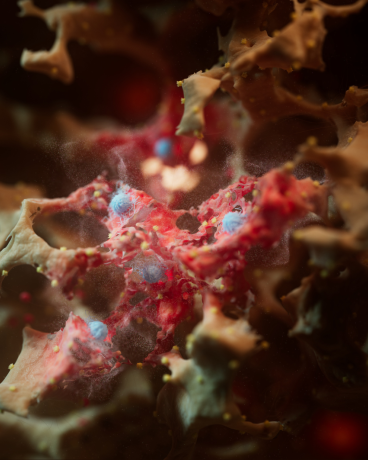
Artistic representation of the internal surface of an inflamed alveolus, showing cellular damage linked to lung cancer risk. Image: © Michael Schwimmer and Jeroen Claus, Phospho Biomedical Animation, European Research Council.
On 4 June 2026, researchers at the Francis Crick Institute and University College London published a study in the journal Cell that has attracted significant attention across the scientific and medical community.
The study, led by Professor Charles Swanton and colleagues, identified a set of 14 proteins in blood plasma that together predict whether a person is likely to develop lung cancer more than five years before they receive a diagnosis.
The research was funded by Cancer Research UK and the European Research Council, and was validated across eight independent datasets from the UK, US, Iceland, China, and Taiwan, covering more than 2,000 lung cancer cases and over 53,000 controls.
This is a meaningful step forward. Here is what the research found, and why it matters.
What the researchers did
The team used machine learning to analyse blood protein data from nearly 48,000 people enrolled in the UK Biobank, a large population study. They looked at which proteins, measured at a single baseline point, were associated with a later lung cancer diagnosis. From 2,923 proteins screened, they identified 14 that, combined with information about age, smoking history, and lung disease, predicted future lung cancer with greater accuracy than existing risk models.
The 14 proteins include markers linked to inflammation, immune activity in the lung, and the biology of alveolar cells, the tiny air sacs where gas exchange takes place. The signature was validated in datasets from multiple countries and, importantly, was associated with future lung cancer in a Taiwanese cohort where over 93% of participants had never smoked.
What is actually being detected
One of the most significant aspects of this research is what the signature reflects.
The proteins do not appear to come from a tumour. Instead, they seem to reflect an altered inflammatory state in the lung that precedes cancer development. Think of it less as detecting the disease itself, and more as detecting the conditions in the lung that make cancer more likely to develop.
The researchers found that this state is elevated by particulate matter air pollution, by the presence of mutant lung cells carrying EGFR mutations, and by a specific inflammatory signal called interleukin-1 beta, or IL-1beta. All three are known contributors to lung cancer risk, particularly in people who have never smoked.
A related review published in Nature in April 2026 helps place this in context. It describes how most lung cancer driver mutations already exist silently in normal lung tissue. What tips mutant cells into cancer is not the mutation alone, but additional factors, including environmental exposures like air pollution, that promote the expansion of those cells. The Cell paper can be understood as the clinical application of that biology: a way to detect that promotion process through a simple blood test.
The prevention finding
Perhaps the most consequential part of the research involves re-analysis of the CANTOS trial, a large cardiovascular prevention trial that tested a drug called canakinumab, which blocks IL-1beta. An earlier analysis of CANTOS had shown that canakinumab reduced lung cancer incidence as an exploratory finding, but the effect was modest across the general trial population.
The new research found that when participants were divided by their baseline 14-protein score, the picture changed substantially. Among those with a high baseline signature, canakinumab reduced lung cancer risk by close to half. Among those with a low signature, there was no meaningful effect.
The number needed to treat to prevent one lung cancer dropped from over 1,500 in the low-signature group to 55 in the high-signature group. That places it in a range comparable to established cardiovascular prevention strategies such as statins.
This matters because it suggests the signature does not only identify risk. It may identify the right people for a specific prevention intervention, at the right time.
Why this is relevant for people affected by lung cancer in Europe
Lung cancer remains the leading cause of cancer death in Europe, with 484,000 new diagnoses every year. Too many people are still diagnosed at a late stage, when treatment options are more limited and outcomes are worse.
The Lung Cancer Europe Charter 2026-2030 commits to timely access to evidence-based early detection and screening for all people affected by lung cancer, access to accurate and timely diagnosis including biomarker testing, and equitable access to care regardless of geography or smoking history.
This research is relevant to all three of those commitments.
Current lung cancer screening programmes in Europe are limited to people over a certain age with significant smoking histories. Only seven of 27 EU member states have implemented or are actively piloting lung cancer screening programmes. People who have never smoked, and those whose risk is driven by air pollution or genetic factors rather than tobacco, are largely excluded from structured risk identification.
A blood-based signature that works in never-smokers, detects risk years in advance, and is linked to a potential prevention strategy represents a different kind of tool. It does not replace CT screening. But it could extend risk identification to people who currently fall outside existing criteria.
It also speaks directly to something Debra Montague, President of Lung Cancer Europe, noted in her Annual Report this year: breakthroughs only matter if people can reach them. The science of prevention has been developing for years. This research begins to make it actionable.
What happens next
The researchers are clear that this is not a test ready for clinical use tomorrow. The study was largely retrospective. Absolute protein quantification across cohorts remains a challenge. Prospective trials with serial sampling will be needed to establish actionable thresholds and define which populations would benefit most.
But the direction is clear. Lung cancer has historically lacked what cardiovascular medicine has long had: a reliable circulating marker of risk, like LDL cholesterol, that can guide preventive treatment in high-risk individuals. This research takes a significant step toward that goal.
Lung Cancer Europe will continue to follow this research closely and ensure that the perspective of people living with lung cancer in Europe is part of the conversation as it develops.