
AI, imaging and lung cancer: what the EU’s new Cancer Image Europe platform means for people across Europe
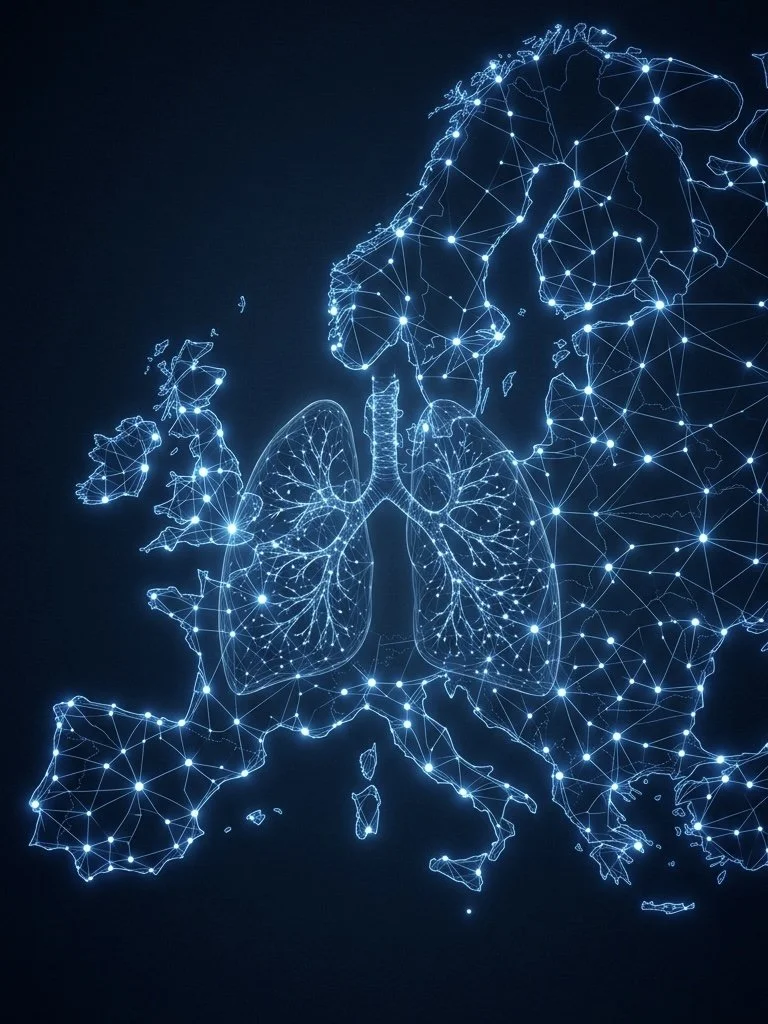
The European Cancer Imaging Initiative is an EU-funded programme connecting cancer imaging data from hospitals and research centres across Europe to develop and validate artificial intelligence tools for diagnosis and treatment. A dedicated project within the initiative, UNICA, is specifically adding lung cancer screening data from 12 medical centres across seven countries.
Here is what it is, what it is designed to do, and why Lung Cancer Europe is paying close attention.
What is the European Cancer Imaging Initiative?
The European Cancer Imaging Initiative is a flagship action of Europe’s Beating Cancer Plan. Its goal is to harness imaging data, artificial intelligence and supercomputing to help clinicians and researchers make faster, more accurate decisions about cancer diagnosis and treatment.
At its centre is the Cancer Image Europe platform, developed by the EUCAIM project and funded with €18 million from the EU’s DIGITAL programme. The platform does not move patient data from the hospitals and research centres that hold it. Instead, it uses a federated approach: institutions retain control of their data, while AI tools can be trained, tested and validated across multiple datasets simultaneously.
As of September 2025, the platform connects 83 imaging datasets across nine cancer types, covering approximately 107,000 subjects. Fifty AI tools are already available to registered users, and by the end of 2026 the platform is expected to host more than 100,000 cases and 60 million images across at least 30 data holders from 15 countries.
Why lung cancer needs this
Lung cancer is the leading cause of cancer death in Europe. Each year, 484,000 people receive a diagnosis. And yet too many of them are still being diagnosed late, at a stage when treatment options are fewer and outcomes are significantly worse.
We know screening saves lives. The evidence base is clear and has been clear for years. But lung cancer screening is still not scaling across Europe the way it should. Access is uneven. In some countries it barely exists. The result is a gap between what is scientifically possible and what people can actually reach, a gap that falls hardest on those in lower-income countries and underserved communities.
This is not a new problem for us. Our Access to Treatment Atlas mapped treatment availability and reimbursement across 30 European countries and found waits of 600 days or more for new medicines in some lower-income European countries. Our annual reports have consistently documented how care varies depending on where you live, not just what disease you have. That inequality is not inevitable. But closing it requires better tools, better data, and systems that can learn from each other across borders.
That is exactly what the Cancer Image Europe platform is being built to do.
Lung cancer data is going into the platform
One of the most significant developments for our community is the UNICA project, funded under the EU4Health programme with €3.9 million in EU co-funding. UNICA is adding large-scale breast, lung and prostate cancer screening imaging data to the federated infrastructure, bringing together 12 medical centres from Slovenia, Portugal, Poland, Lithuania, Greece, Germany and Ukraine.
Three things stand out about this. First, lung cancer imaging data from diverse European populations will be available for AI development and validation at a scale not previously possible. Second, those populations include countries that have historically been underrepresented in large-scale research, which is essential if AI tools are going to work equitably across Europe rather than only in the best-resourced settings. Third, the federated model means that even institutions in countries with limited resources can contribute to and benefit from a shared infrastructure, without needing to transfer sensitive data or build expensive systems of their own.
UNICA’s stated aim is not just to pool data. It is to pilot cutting-edge AI models for cancer screening while promoting patient data altruism: the idea that people who contribute their data to research are doing so to help others, and that this contribution should be recognised, protected and used responsibly.
AI-powered screening centres: a network taking shape
In February 2026, the European Commission issued a call for healthcare organisations to join a European network of AI-powered advanced screening centres. The network is intended to accelerate the adoption of AI solutions for cancer prevention and diagnosis, building directly on the Cancer Image Europe infrastructure.
This is a shift from infrastructure-building to implementation. The platform is no longer just a research tool. It is becoming a foundation for clinical deployment, a way of testing whether AI tools developed in research settings can genuinely improve outcomes when used in real hospitals with real patients.
For lung cancer, this is significant. AI-assisted analysis of CT scans is already showing promise for earlier detection of nodules that might otherwise be missed or misclassified. As these tools are validated across larger, more diverse datasets, the case for embedding them into national screening programmes becomes harder to ignore.
What this means in practice
The Cancer Image Europe platform is not a magic solution. Building infrastructure is not the same as delivering equity. An AI tool validated on datasets from 15 countries still needs to be implemented in clinical practice, reimbursed by health systems, and made available to people regardless of their postcode or their country’s health budget.
Those are policy challenges as much as technical ones. And they are challenges we will keep pressing on.
But the infrastructure being built here is genuinely important. For years, one of the barriers to progress in lung cancer research and diagnosis has been fragmentation: datasets too small to train reliable AI, clinical centres working in isolation, evidence generated in one country that never reaches another. The Cancer Image Europe platform is a direct response to that fragmentation.
It is also, notably, being built with patient privacy and data sovereignty at its core. The federated model means data stays where it is. It is not aggregated into a central repository that creates single points of failure or risk. People living with lung cancer who contribute their data to research deserve to know it is being handled with the highest standards of protection. This platform is designed to guarantee that.
A moment to pay attention
Europe’s Beating Cancer Plan has delivered a series of commitments over recent years. Some have been kept. Some remain aspirations. As EU budget conversations continue, there is real pressure on the initiatives that sit within this framework.
The Cancer Image Europe platform has already demonstrated results. It is operational, it is growing, and it is beginning to deliver the kind of cross-border AI validation that was not previously possible. That is an achievement worth protecting and building on.
For lung cancer specifically, we are in a period of genuine scientific momentum. New treatments, longer survival, a clearer understanding of what good care looks like. The question is whether the systems around those advances are built well enough to deliver them equitably. A shared, federated imaging infrastructure that helps clinicians detect lung cancer earlier and more accurately across all of Europe is part of that answer.
We will be watching this initiative closely and will keep our community informed as it develops.
*The European Cancer Imaging Initiative is a flagship action of Europe’s Beating Cancer Plan. The Cancer Image Europe platform is developed by the EUCAIM project. More information is available at [cancerimage.eu](https://cancerimage.eu) and on the [European Commission’s digital strategy pages](https://digital-strategy.ec.europa.eu/en/policies/cancer-imaging).*