
Could a blood test reveal the tumour microenvironment? What new research means for lung cancer
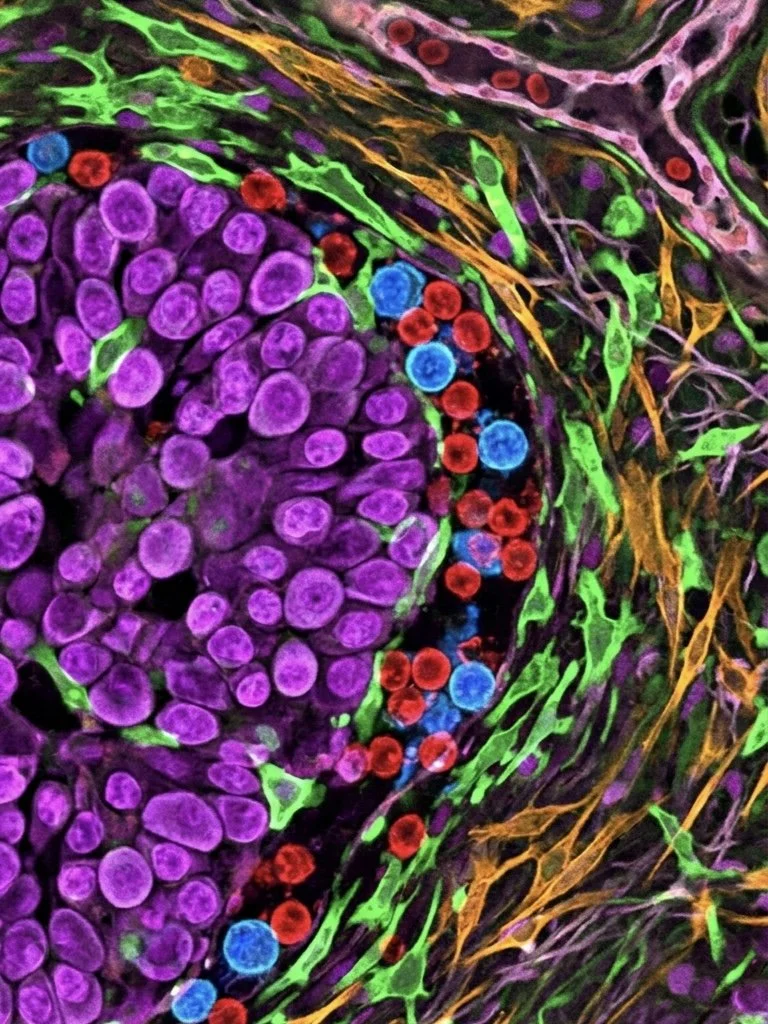
A study published today in Nature is attracting significant attention from the research community.
It explores a question that matters deeply to people affected by lung cancer: could we learn more about how a tumour behaves, without always needing to take a piece of it?
What is the tumour microenvironment?
A tumour is not just made up of cancer cells. Surrounding and interacting with those cells is a complex community of immune cells, structural cells and other biological components. Together, these form what researchers call the tumour microenvironment (TME).
The TME can influence how a cancer grows, spreads and (critically) how it responds to treatment, including immunotherapy. Understanding it better could help predict who will benefit from certain treatments and who might not.
The challenge: understanding the TME usually requires tumour tissue
To study the TME, researchers and clinicians typically need a biopsy - a sample of tumour tissue. But biopsies have limitations. They can be difficult or risky to obtain, particularly in lung cancer. A single biopsy captures only one part of a tumour at one point in time, and may not reflect what is happening across the whole disease. Repeat biopsies over the course of treatment are often impractical.
This means there is a real gap between what we would like to know about the TME and what we can feasibly measure in clinical practice.
What the new research explores
The study, led by researchers at Stanford University and published in Nature on 6 May 2026, introduces a framework for mapping the TME using machine learning.
The researchers identified nine recurring patterns -called spatial ecotypes - in how different cell types organise themselves in and around tumours. These patterns were found across multiple cancer types, including lung cancer, and were linked to differences in clinical outcomes and response to immunotherapy.
The most significant finding is that these patterns may not require tumour tissue to detect. Using a technique called cell-free DNA (cfDNA) methylation profiling, which analyses DNA fragments shed into the bloodstream, the researchers developed a deep learning tool, Liquid EcoTyper, that could identify these spatial ecotypes from a blood sample.
In a cohort of people with melanoma receiving immunotherapy, blood-based ecotype levels before treatment began were strongly associated with whether patients went on to benefit from treatment.
What this could mean for lung cancer
Lung cancer was directly included in the research findings. The study found that spatial ecotypes outperformed established immunotherapy biomarkers, including PD-L1 expression and tumour mutational burden, for predicting response and survival specifically in lung cancer, alongside melanoma, bladder cancer and gastric cancer.
It is important to be clear about where the evidence currently stands. The liquid biopsy component of this research was validated in a melanoma cohort. Lung cancer-specific liquid biopsy findings have not yet been published. This is early-stage research, and it is not ready for routine clinical use.
But the direction is significant. For people with lung cancer, where repeat biopsies are often difficult and where tumour heterogeneity - variation within and between tumours - is a known challenge, less invasive ways to understand cancer biology could have real implications for treatment personalisation.
As leading cardiologist and researcher Eric Topol noted on publication: the field has long known how important the tumour microenvironment is, but has lacked a non-invasive way to assess it.
Why this matters: access to better information
At Lung Cancer Europe, we believe that better information leads to better care. Access to biomarker testing - understanding the biology of an individual’s cancer - is one of our core asks. It is embedded in our Charter and in our key messages, because right now, access to that information is inconsistent and unequal across Europe.
Research like this points toward a future where understanding the tumour microenvironment could become more accessible, more complete and less burdensome for people with lung cancer.