
“We Are an Organisation That Moves”: Debra Montague Opens the Inaugural Lung Cancer Europe Conference
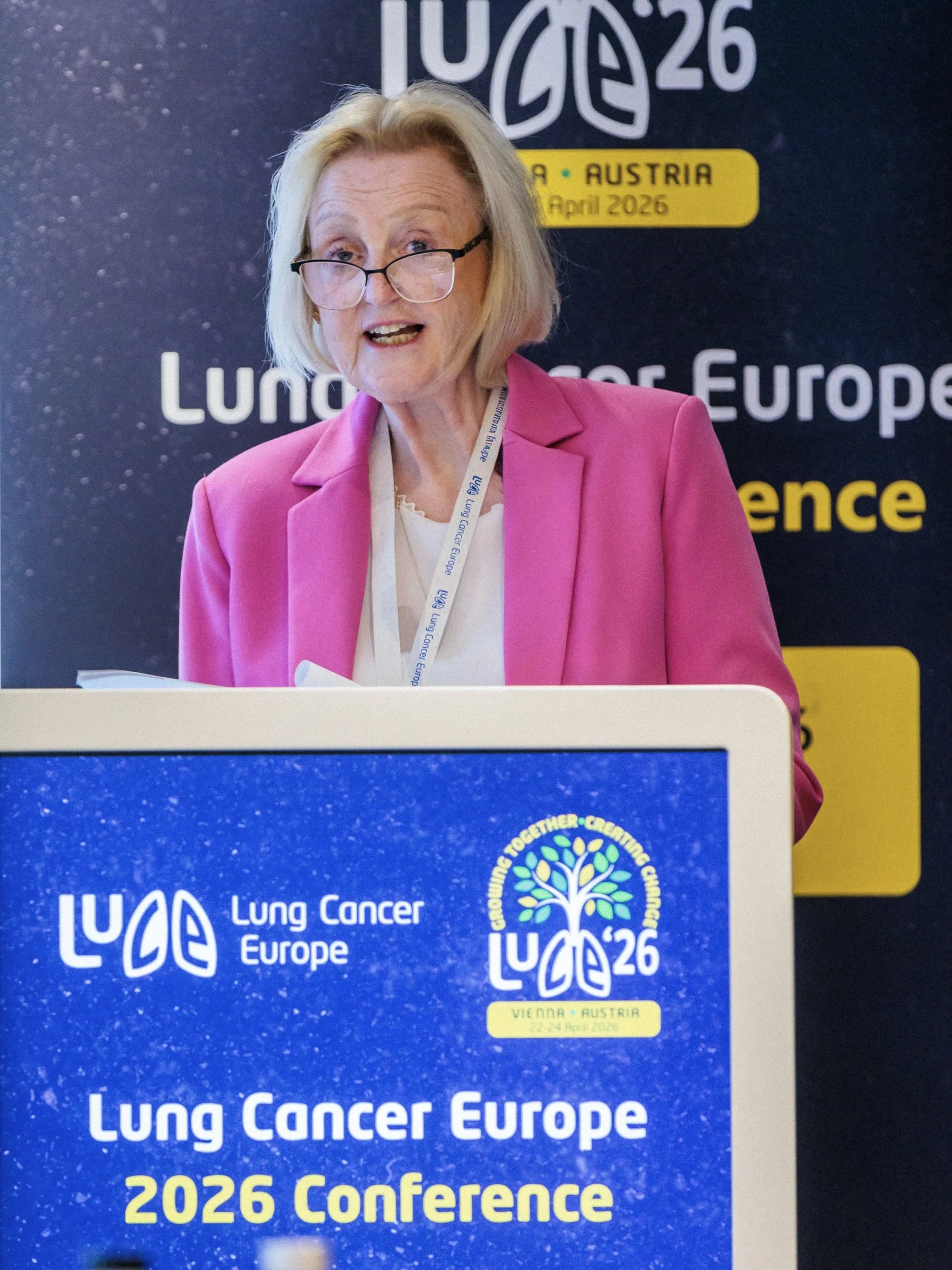
Debra Montague, President of Lung Cancer Europe, speaking at the inaugural Lung Cancer Europe Conference in Vienna, April 2026.
On 22 April 2026, over 140 members, clinicians, researchers, policymakers and people with lived experience of lung cancer gathered in Vienna for the first-ever Lung Cancer Europe Conference.
Opening the three-day event, Lung Cancer Europe President Debra Montague delivered both her annual President’s Report and a keynote address that set the tone for everything that followed.
Her message was clear: the science is moving. The systems are not keeping up. And that gap costs lives.
Welcome to Vienna: A Community That Showed Up
Speaking to a packed room at the inaugural conference, Debra Montague opened with a moment of recognition for the community she leads.
“We have members here today who have been part of this community for years, who show up for people affected by lung cancer across Europe every single day, often with very little resource and very little recognition,” she said. “That is a remarkable group of people to be in a room with. And I do not take it for granted for a second.”
Lung Cancer Europe is the voice of Europeans impacted by or at risk of lung cancer - an umbrella organisation bringing together lung cancer patient advocacy groups from across the continent. The conference, three years in the making, brought together that community for the first time under one roof.
The Moment We Are In: Progress and Its Limits
Debra Montague was candid about both the extraordinary progress in lung cancer treatment and the systemic failures that prevent patients from accessing it.
“The treatment landscape for lung cancer has changed beyond recognition in the last decade,” she told delegates. “New targeted therapies. People living years longer than was thought possible not so long ago. That progress is real, it is significant, and for the people we represent it is everything.”
But she was equally clear about what stands between that progress and patients.
In lower-income European countries, people can wait over 600 days for access to medicines that already exist. Lung cancer screening - which has a clear evidence base and is known to save lives - remains unavailable to most people across Europe. And at EU level, budget conversations are putting hard-won commitments under pressure.
Lung cancer remains the leading cause of cancer death in Europe, with 484,000 new cases and 376,000 deaths every year. “That has to mean something to everyone here,” Montague said.
The President’s Report 2025–2026: A Year of Action
Earlier in the day, Debra Montague delivered the Lung Cancer Europe President’s Annual Report 2025–2026 to the General Assembly - an honest account of where the organisation stands, what it has delivered, and where it is headed.
Growing Stronger
Lung Cancer Europe now represents member organisations across more than 27 countries in the WHO European region. In 2025, the organisation launched its Member Forum - with 20 in-depth interviews conducted with member organisations across Europe - and held its largest ever Members’ Meeting in Budapest in September 2025.
Membership is not just growing. It is deepening.
Evidence That Drives Change
The organisation’s annual reports remain one of its most powerful tools for advocacy.
The 10th Lung Cancer Europe Report - the largest global lung cancer patient survey to date, reaching 2,204 people across 31 countries - focused on mental health. The findings were stark: widespread distress, fear and isolation, and many patients receiving no mental health support at all throughout their lung cancer journey. The report launched at ESMO 2025 in Berlin and has been translated into 17 languages.
The 11th Report, launched at ELCC 2026 in Copenhagen, went further - exploring inequalities in access to psychological support across Europe, and for the first time including dedicated analysis on small cell lung cancer. The findings were consistent with the 10th: emotional wellbeing is not a luxury. It is part of care.
Work is already underway on the 12th Report, which will focus on survivorship - exploring what it means to live longer with lung cancer, and the ongoing challenges that brings.
Giving Small Cell Lung Cancer a Voice
One of the most significant areas of focus this year has been small cell lung cancer (SCLC) - a community Debra Montague described as having “existed for too long in the shadow of other cancer types.”
The 11th Report’s dedicated SCLC analysis found that nearly two thirds of small cell lung cancer patients rated the mental health impact of their diagnosis as negative - worse than the overall lung cancer average. 59% were never offered any mental health support. Not once.
Working with member organisation Longkanker Nederland and running a pan-European survey across more than 20 countries, Lung Cancer Europe built the most comprehensive patient-centred picture of the SCLC journey to date. Just before the conference, that evidence was brought to an advisory board of clinicians, researchers and industry partners - with the explicit goal of turning findings into action.
“Small cell lung cancer patients have waited long enough,” Debra wrote in the report. “This is their year.”
Practical Action: FAST-NGS, the Access Atlas and LuCEGPT
The report highlighted three flagship initiatives that exemplify Lung Cancer Europe’s commitment to moving from policy ask to practical change.
FAST-NGS is a pilot programme bringing next-generation sequencing directly into hospitals, reducing biomarker testing from weeks to 24–48 hours. The first pilot site is Metaxa Cancer Hospital in Piraeus, Greece, working in partnership with Thermo Fisher Scientific. Just days before the conference, the Lung Cancer Europe team visited Metaxa alongside the Thermo Fisher Scientific team to progress next steps. If successful, the model will be brought to further countries.
The Access to Treatment Atlas maps treatment availability and reimbursement across 30 European countries - a live evidence base for advocacy on access to treatment, biomarker testing and lung cancer screening. An expanded Atlas II is in development.
LuCEGPT is perhaps the most forward-looking initiative: a patient-centred AI chatbot built on the expertise and values of Lung Cancer Europe. With people already turning to commercial chatbots for information at their most vulnerable moments - and receiving unreliable answers - LuCEGPT is being developed as a trusted, accessible alternative. Version 1 is currently in development, with patient, clinician and psychologist input built into the design from day one.
“This is AI in service of people,” Debra said. “Not the other way around.”
Communications and Reach
The organisation’s digital presence grew dramatically in 2025. LinkedIn followers grew from 2,999 to over 9,500 in a single year. The mailing list grew fivefold. Lung Cancer Europe now reaches over 300,000 people per month across its digital channels.
A new multilingual news platform, supported by AI-assisted translation, is making trusted lung cancer information accessible across languages - because, as Debra put it, “no one should be without the information they need because of the language they speak.”
Policy: Building the Foundations, Using Them
In November 2025, Lung Cancer Europe co-organised a high-level Call to Action event at the European Parliament, bringing together EU policymakers, clinicians and patient advocates. That Call to Action has since been endorsed by Cancer Patients Europe, the Lung Cancer Policy Network, the European Health Management Association and MSD.
The organisation’s position statement on the WHO Lung Health Resolution was reposted by the Malaysian Health Minister and viewed over 14,000 times on LinkedIn.
Looking ahead, Debra was clear about the priorities: protecting commitments under Europe’s Beating Cancer Plan, maintaining funding for large-scale screening programmes, and building on the WHO Lung Health Resolution. “These are not abstract positions,” she wrote. “They are the difference between people getting diagnosed early and people being diagnosed too late.”
What these days are for
In her conference opening, Debra set out the purpose of Vienna 2026 - not simply to inform, but to be genuinely useful.
Day 1 brought together leading voices in European lung cancer policy and care, with keynotes from Hugo Soares on building national cancer mission hubs, Dr Mary Bussell on moving from consensus to action, Elisabetta Zanon of the European Cancer Organisation on Europe’s Beating Cancer Plan, MEP Nikos Papandreou on how Europe can deliver for patients, and Cecilia Pompili on truly patient-centred care.
Day 2 will go deeper - exploring AI and data in lung cancer care, personalised treatment, federated data for advocacy, shared decision-making and clinical trials. Day 3 brings member organisations together for peer exchange and co-creation.
“I want everyone to leave with something they can take home and act on,” Debra told delegates.